My holiday music website is where I post copies of all my previous holiday mixes and I've just given it a new look in anticipation of the upcoming holiday season. You can check it out anytime at https://www.marksholidaymixcds.net/#. I'm still testing the individual entries and links to make sure they're fully functional, so please let me know if you have trouble accessing any of the features.
I've been circulating a new holiday mix each year since 2005 and can't say for sure just how many new mixes I'm going to want to prepare. Maybe it's time for me to find something new to do for the holidays? A number of friends get into baking at Christmas, and that sounds like a promising activity. We'll see how I feel. But if I make another mix this December, you can bet it will be posted on the website!
I hope everyone's enjoying a pleasant summer and look forward to posting more after the cold weather arrives.
On Saturdays during the Christmas season we typically rummage around our video vault to find an old holiday-based sketch from Saturday Night Live to share. Today's sketch is from December 15, 2012 featuring guest host Martin Short and musical guest Paul McCartney, It's immediately followed by Paul McCartney performing "Wonderful Christmastime," which, in my opinion is one of the worst holiday songs and wost Paul McCartney songs ever. The sketch is pretty good, though. Enjoy!
It's Christmas Eve, everybody — that magical evening when many families around the world will be spending time together in anticipation of Christmas Day. I've got time to share just a little bit of background about the remaining three tracks on Be a Santa!, my holiday mix for 2021. I'll probably have some additional comments over the next few days before we close out this holiday season, but for now let me wish you a very Merry Christmas and a Happy New Year!
Here's some thoughts on Tracks 35-37 of this year's mix:
Track 37 Peace at Least, Rotary Connection (1968)
The Chicago-based band Rotary Connection was founded in 1966 by Marshall Chess, the son of the founder of Chess Records. Most of the groups on the Chess label played either rock or blues and Marshall was hoping to lead his new group in a different direction. His wanted Rotary Connection to experiment with different styles of music, so he recruited musicians of varied backgrounds and styles to join, many pf whom had previously played with other Chess bands.
Among the last to join the new band was the label's receptionist, Minnie Riperton, who would later go on to have a successful solo career that was tragically cut short due to her death from cancer in 1979. Riperton, who topped Billboard's Hot 100 in 1975 with her hit "Lovin' You," was the mother of actress and comedienne Maya Rudolph.
As its founder had intended, Rotary Connection proved to be a difficult band to characterize, although a number of critics have described the group's style as "psychedelic soul." Unfortunately, the lack of a signature sound effectively limited the group's popularity and while their first two albums attracted attention in some quarters, neither sold especially well.
Their third album "Peace," released in late 1968, featured a collection of Christmas songs, nearly all of them original. True to form, the musical style of the album varies from one track to the next; however the emphasis on peace and love never wavers, and it made the album the perfect tonic for the end of traumatic year then winding down. "Peace" was only a modest success commercially, but in many homes its socially conscious message made it among the most consequential holiday albums ever recorded.
"Peace at Least" is a particularly impious track, suggesting, as it does, that Santa's generosity and goodwill is the result of smoking mistletoe.
Every year, I have the same question Something that puts me so very uptight Where does Santa get all those gifts from Why is he riding so late at night I know why (I know why) The kid is high (he's high) The kid is stoned (stoned)
'Cause he smokes (mistletoe) I said, I said he smokes (mistletoe) Oh, he smokes (mistletoe) Everyone should have a peace at least once a year
But he's an institution We like him like he is What would ever happen If he gave some to the kids
Rudolph the Red-Nosed Reindeer, William Shatner, featuring Billy Gibbons (2018)
Track 35
Santa Rides Again, Sam Watt and the Gang at Gallo Wine (1950)
This track comes from a promotional record produced and presumably circulated in 1950 by the E.& J. Gallo Wine Company of Modesto, California. It seems to have been created to promote Gallo Wine, to thank the company's customers and to give listeners a healthy dose of holiday spirit:
The folks who sell you Gallo wine are really most sincere
When we say "Merry Christmas and a Happy, Bright New Year!"
Thanks to you and you and you — the friends of Gallo Wine
We're lucky to have friends like you
We hope you're doing fine
All year long we tell you that Gallo can't be beat
But leave that for another time, right now let us repeat
Thanks to you and you and you — the friends of Gallo Wine
We're lucky to have friends like you
We hope you're doing fine
These sorts of holiday promotions were not uncommon in the 1940s, '50s and '60s, as they were a good way for businesses to thank their customers and encourage them to maintain their relationships in the year ahead.
One of the better known such holiday promotions was by the Line Material Company, a manufacturer of electric equipment. From 1957-62, Line Material produced a series of annual promotional records that were send to employees and customers to celebrate the holidays. These holiday tunes were produced by a fellow named John McCarthy, and they were both entertaining and professional. I've included a number of these songs on previous mixes of mine, including the title track to my 2007 "Let's Trim the Christmas Tree" mix and "The Day that Santa Was Sick," which appeared on last year's mix, "All Alone on Christmas." I and most other holiday music collectors first learned of these Line Materials tracks from Lee Hartsfeld, who curates the terrific "Music You Possibly Won't Hear Anyplace Else" blog.
Here's the Gallo Wine promotion included on this year's mix:
Track 34 Christmas at the Airport, Nick Lowe (2013)
Nick Lowe
Around the time I left for college in the late '70s there were some big changes taking place in the American rock music scene. I'd been into the whole California soft rock scene (CSN and CSNY, Fleetwood Mac, the Eagles, Steely Dan); I loved the Beatles, the Stones and David Bowie; I was crazy about Motown and all kinds of R&B — hell, I was even getting into disco. I had a couple of shows on our college radio station and hung around with other folks who were big into music and what was really capturing the attention of my edgier friends was the punk, new wave and power pop stuff that was coming out of London and New York — The Clash, Elvis Costello, The Police, Talking Heads … and British rocker Nick Lowe, for example.
Lowe earned his chops on the London pub scene in the early to mid '70s as a member of the band Brinsley Schwarz. After leaving that band in 1975, Lowe played with Rockpile with Dave Edmunds, recorded a number of well-received solo albums and produced records by such artists as Elvis Costello, Graham Parker and the Rumour and The Damned. He was a prolific songwriter during this period, writing or so-writing such hits as "So It Goes," "I Love the Sound of Breaking Glass," "Cruel to Be Kind," and "(What's So Funny 'Bout) Peace, Love and Understanding." Lowe's version of "Cruel to be Kind" made it all the way to number 12 on the Billboard Hot 100 in 1979, and his singles "Crackin' Up" and "Switchboard Susan" were also big hits.
Although he released a string of fine records over the next 30 years, Lowe wasn't able to match the success he enjoyed in the late 1970s. To be honest, I sort of lost track of Nick Lowe until 2013, when he released a terrific holiday album called Quality Street: A Seasonal Selection for All the Family, which record I'm happy to say was noted in this blog. David Letterman had Lowe on the Late Show in December 2013, and we reported on that here, too. For some reason, however, I've never included anything from Quality Street on my previous mixes. I'm happy to remedy that oversight this year by featuring "Christmas at the Airport."
Rudolph (You Don't Have to Put on the Red Light), mojochronic (2010)
I found this little number in a file on my computer marked "Holiday Mashups," where it's been sitting for about ten years. I can't say I know a whole lot about mojochronic, but from what I can tell it's a person or group of people who combine two or more individual tracks into surprising and not-quite-discordant mashups. The two songs mashed together here, of course, are Rudolph, the Red-Nosed Reindeer and Roxanne, by The Police. The common element is that Rudolph's nose is red and Roxanne, a prostitute, likely plies her trade in a red-light district. I'm not sure there's very much more that needs to be said about this one, other than the fact that the video does a great job of cutting up the classic 1964 Rankin Bass television special to track to the beat of The Police. Enjoy.
Track 32
St. Nicolas, Filobin (1978)
This is another track I've had on my computer for quite a while but haven't found the right spot for until now. Unfortunately, I don't have a whole lot of information about this track. All I can really report is that Filobin is the stage name of Guy Philobin, a French animator and musical clown who released this holiday single in 1978 with a B-side titled "The Toys of a Wise Child." It's a cute little number, and I remember just enough of my high school French to be able get a rough gist of what the guy's saying.
Only three more tracks to review, and I'm hoping to post something on them around the same time Santa finishes his Christmas Eve deliveries in France tomorrow night!
Continuing with our review of the 37 tracks on this year's holiday mix, here's a look at the next batch of songs and clips:
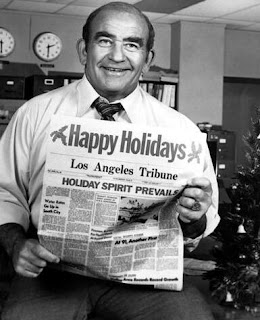
Track 31 Excerpt from "A Visit from St. Nicholas," read by Ed Asner (1987)
As noted earlier, we lost three stars of The Mary Tyler Moore Show this year: Cloris Leachman, Gavin MacLeod, and one of my favorite celebrities of all time, the great Ed Asner. Asner, of course, played newsman Lou Grant two different TV series: The Mary Tyler Moore Show (1970-77), half-hour sitcom based in a Minneapolis TV station; and Lou Grant (1977-82), a one-hour drama based in a Los Angeles-based daily newspaper. Asner won Emmys for his work on both series and others as well; in fact, he won more performance-based Emmys than any other male actor.
Asner was also known for his political activism and generous support of a wide range of charitable causes. In the early 1980s, he served two terms as president of the Screen Actors Guild, a job previously held by Republicans George Murphy and Ronald Reagan. During his tenure as SAG's president, Asner actively opposed President Reagan's policies in Central and South America while advocating for union members and the less fortunate in this country and elsewhere.
Upon learning of Asner's death, filmmaker and activist Michael Moore recalled as follows:
When I was making my first film, Roger & Me, I was broke, so I wrote to some famous people to ask for help. Only one responded: Ed Asner.
“I don’t know you, kid, but here’s 500 bucks,” said the note attached to the check. “Sounds like it’ll be a great film. I was an autoworker once.”
Asner loved to work, and he played hundreds of other characters in addition to his iconic Lou Grant role. Generations of children know him for voicing the role of widower Carl Fredricksen in Disney's animated film Up! I'm not sure if this was intentional or happenstance, but he had significant roles in at least a dozen popular Christmas movies, including the Emmy-winning 1977 TV film "The Gathering." Remarkably, he played Santa Claus himself in at least half a dozen movies and TV shows, including the hit film Elf (2003).
Asner remained active to the very end — in fact, he was posting tweets just a couple of days before he died this past August 29. Ed was a powerful presence in the world and we won't soon see his like again.
When actor Jamie Farr was hired to appear on the new CBS TV series M*A*S*H in 1972 he was scheduled to appear in a single episode as Maxwell Klinger, a corporal who wore female clothing in the hope that he'd be discharged from the service as unfit for duty. The Klinger character proved popular, however, and Farr was asked back for several additional episodes until by the fourth season of the popular program he became a regular cast member.
M*A*S*H has always been one of my favorite shows, and while Klinger was never one of my favorite characters I've always thought that Jamie Farr seemed like an awfully good guy. Unfortunately, his work as Klinger seems to have permanently typecast him and he's had trouble landing other work. Believe it or not he's now 87 years old, and I know everyone will join me in extending him our warmest holiday wishes this year, too.
Track 29
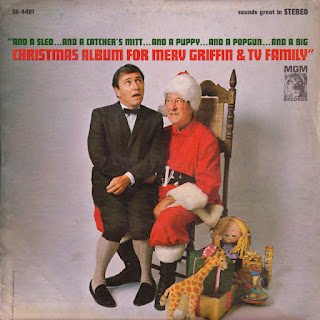
Santa Claus Is Coming to Town, Arthur Treacher (1966)
Arthur Treacher was an English stage and film actor best known for his portrayal of butlers Jeeves in a series of Shirley Temple movies and Constable Jones in the classic Disney film Mary Poppins. He's also known for his work as announcer and sidekick on the Merv Griffin Show from 1965-70. I guess what I remember him best for is the chain of fast food restaurants to which he lent his name starting in the late 1960s. Arthur Treacher's featured fried fish, fried chicken and chips (french fries), and at its peak the chain boasted more than 800 stores. Today, only one remains.
Treacher's version of "Santa Claus Is Coming to Town" was recorded as part of a holiday album released in 1966 by "Merv Griffin and his TV Family." The collection also included songs by Frankie Michaels, who had won a Tony Award earlier that year for his role in the Broadway show Mame; actor David Soul; Gilbert Price, operatic baritone and actor; and, of course, several by Griffin himself. This track was ultimately released as a single and selected by Billboard magazine as one of the standouts of the holiday releases that year. I don't know that I'd give it that much credit myself, but it's a cool little number and a good representative song from its time.
Track 28
Little Drummer Boy, William Hung (2004)
I'll likely be back tomorrow with some quick thoughts on one or more of the six remaining tracks on this year's mix.